
Where do restaurants actually make money — and where do they quietly lose it?
Most multi-unit and independent restaurants discover food-cost problems when the period closes. By then, the month is already written. Price spikes, portion drift, waste, and late supplier invoices have shaped the result — and the team is left explaining history instead of correcting the business.
This is not only a Turkey problem or a US problem. Operators in the United Kingdom, the Netherlands, France, Poland, and across Europe run into the same pattern: growth and busy service hide small daily leaks until the month-end report makes them look sudden.
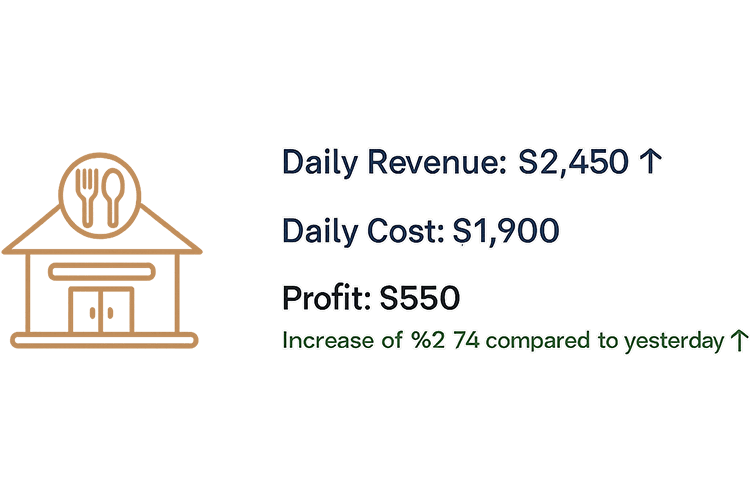
Food cost rarely collapses overnight
Food cost rarely “blows up” in a single day. It drifts. A few cents on cheese. A heavier hand on oil. A delivery that sits too long. An invoice entered a week late. None of these feel dramatic in the moment — together they move your food-cost percentage and erase profit.
If your only reliable cost conversation happens after accounting closes the books, you are managing last month’s story, not this week’s operation.
Four ways control slips before month-end
1) Supplier price changes without recipe updates
Ingredient markets move constantly. If plate costs stay frozen in an old spreadsheet while purchase prices rise, every sold item quietly becomes less profitable. The menu still looks busy. The margin does not.
2) Recipe and portion drift on the line
Recipes are the financial constitution of the kitchen. When portions stretch “just a little” for speed or guest preference — more cheese, extra garnish, oversized scoops — theoretical cost and actual usage separate. Over a month, that gap becomes a food-cost surprise.
3) Waste and spoilage that never become a number
Prep mistakes, overproduction, spoilage, and theft do not always appear in a clean report. Without daily visibility, waste hides inside “higher food cost” with no owner and no timestamp.
4) Late invoice entry and delayed stock truth
If invoices arrive late or are posted after the week is over, inventory and cost views are incomplete while decisions are still being made. Teams order, produce, and discount on incomplete data — then wonder why month-end does not match the floor’s memory of a “good month.”
| Metric | Example | Why it matters |
|---|---|---|
| Daily revenue | $2,450 | Shows demand and mix for the day |
| Daily cost | $1,900 | Reflects purchases + recipe-driven usage |
| Daily profit | $550 | Makes leakage visible before month-end |
| Change vs yesterday | +2.74% | Turns costing into an operating habit, not a monthly shock |
Numbers are illustrative. The point is cadence: daily visibility beats a single month-end autopsy.
Theoretical vs actual: the control gap
Strong operators separate two truths:
Theoretical usage — what should have been consumed based on recipes and sales.
Actual usage — what inventory counts, waste logs, and purchases say really moved.
The variance between them is where money disappears: over-portioning, waste, theft, wrong recipes, or missing invoices. If you only reconcile that variance once a month, you lose weeks of corrective action.
Month-end food cost is a scoreboard. Daily theoretical vs actual is the game film.
Why “busy” months still lose money
Revenue can rise while profit falls. High ticket counts hide inefficient prep, expensive promotions, and delivery mix that looks successful until commissions and packaging are fully loaded. Without daily cost attached to sales, teams celebrate top line and miss the leak.
That is the heart of the question behind the video: where do restaurants actually make money? Not in the ticket alone — in the gap between what was sold from recipes and what the stockroom truly lost.
What to do instead of waiting for month-end
1. Keep live recipes tied to purchase prices so plate cost updates when suppliers move.
2. Sync POS sales into recipe-based deductions so theoretical usage refreshes every service.
3. Post invoices and receive stock quickly — incomplete purchasing data is incomplete costing.
4. Review a simple daily P&L: revenue, cost, profit, and variance vs yesterday or last week.
5. Investigate theoretical vs actual weekly (or daily in high-volume sites) while the cause is still findable.
If your team still waits for accounting to close the books before discussing food cost, you are managing history — not the business.
A practical operating cadence
| When | What to review | Owner |
|---|---|---|
| Daily | Revenue, cost, profit, obvious spikes | GM / owner |
| 2–3× week | Invoice posting completeness, receiving | Purchasing |
| Weekly | Theoretical vs actual by category | Ops + kitchen |
| Month-end | Confirm trends already known | Finance + ops |
Month-end should confirm what daily and weekly reviews already surfaced — not reveal them for the first time.
Closing
Restaurants lose food cost control before the month ends because the leaks are daily and the reports are monthly. Flip the cadence. Connect purchases, recipes, sales, and inventory so you can see where money is made — and where it escapes — while you can still act.
Qapera is built for that operating rhythm: recipe costing, inventory, production, and daily profit visibility for restaurants and food manufacturers across the US, UK, and Europe.
Control the day, and the month takes care of itself.