
Ask ten café owners what makes a coffee shop successful and you will hear the same words: location, vibe, baristas, beans. Those matter. But they are also the factors every competitor can copy once the market matures. The shops that stay profitable after the opening honeymoon are usually the ones that treat cost, inventory, and daily P&L as seriously as latte art.
This article expands a framework we first shared on LinkedIn — four structural criteria, then the lever that actually separates durable winners: operational efficiency and cost management — supported by a recommended expense model for sustainable coffee shops.
1. Location — the first button on the shirt (~47%)
If you fasten the first button wrong, every button after it lines up poorly. Location is that first button. Foot traffic, rent burden, visibility, parking, office vs residential mix, and competitor density are hard to fix after you sign. A brilliant concept in the wrong unit often underperforms a simple concept in the right one.
- Wrong location does not only lower sales — it also locks you into a rent ratio that can crush the rest of the P&L.
- Changing location is the most expensive correction; most operators never fully recover the opening capital.
- Treat site selection as a financial decision, not only a brand decision.
2. Architecture, atmosphere, and the franchise reality (~21%)
Design and atmosphere convert walk-ins into habits. But building a zero-to-one concept from scratch is high risk: you must invent brand perception, SOPs, supply, and training at once. Joining a franchise (or a proven multi-unit playbook) can reduce that risk when the system already owns customer perception — if the royalty and supply economics still leave room for your target margin.
Independent concepts can win. They just need the same discipline franchises force: standard recipes, purchase rules, and measurable service quality — without waiting years to invent them.
3. People and service (~16%)
The best espresso in the city can still lose to average coffee served with care — or win with elite coffee ruined by cold hospitality. Staff quality is the only factor that touches every guest, every day. Hiring, training, and retention are operating costs, but they are also the front line of revenue defense.
4. Product quality (~16%) — table stakes, not a moat
Good beans used to differentiate. Today they are the entry ticket. Guests expect competent coffee; they rarely pay a premium forever for “we source well” alone. Product quality keeps you in the game. It rarely finishes the game by itself.
When location, vibe, service, and product are roughly equal, cost control decides who stays open.
The real separator: operational efficiency and cost management
Once the four criteria above are “good enough,” profitability is decided in the back of house: recipe cost, inventory accuracy, waste, portion control, supplier prices, and how fast you see variance. That is the same thesis we explore in our pieces on food-cost drift before month-end and the industry’s silent profit leak — cafés are not exempt.
Payback periods are stretching too. Successful café investments that once returned capital in roughly 14 months now often sit nearer 18 months — another reason millimeter-level cost discipline is not optional.
A recommended cost model for sustainable coffee shops
The chart below is a recommended distribution of costs as a share of revenue for sustainable coffee shops — not a guarantee for every unit. Takeaway-heavy sites, luxury rents, or self-order heavy formats will shift the mix. Use it as a diagnostic benchmark.
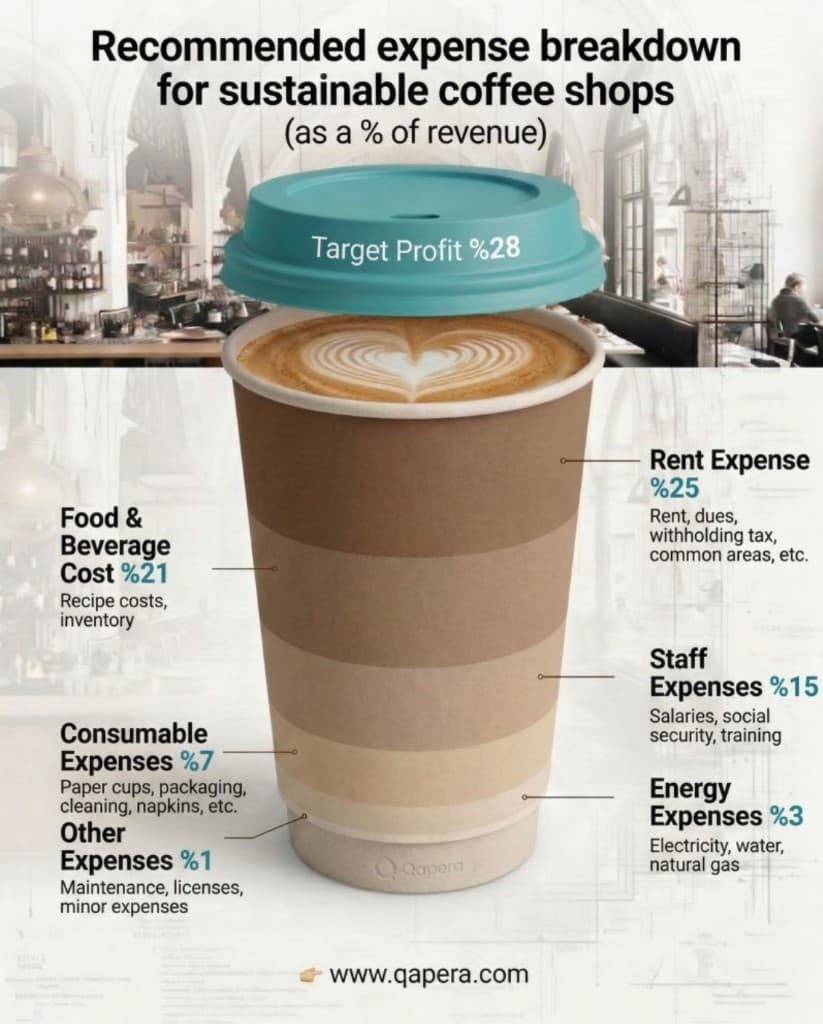
| Line | % of revenue | What it usually includes |
|---|---|---|
| Rent | 25% | Lease, dues, withholding, common charges |
| Food & beverage cost | 21% | Recipe COGS, inventory |
| Labor | 15% | Wages, social charges, training |
| Consumables | 7% | Cups, packaging, cleaning, napkins |
| Energy | 3% | Electricity, water, gas |
| Other | 1% | Maintenance, licenses, small opex |
| Profit target | 28% | After the operating lines above |
Percentages are a planning benchmark. Local rent markets and franchise royalties can force a different mix — rebalance before you open, not after cash runs short.
How to use the model in practice
- If rent alone is far above ~25% of expected mature revenue, the other lines will struggle to fund a healthy profit.
- Keep F&B near the low twenties with living recipes, counts, and theoretical vs actual — not spreadsheet folklore.
- Treat cups and packaging as a managed cost center; they quietly erode takeaway margins.
- Review the mix weekly at first, then monthly — the same cadence as serious food-cost control.
What to do next
Score your concept on the four criteria honestly. Then put numbers under the cup: rent ratio, recipe COGS, labor, and waste. If you cannot see those weekly, you are managing taste — not a business.
Qapera helps multi-unit and independent food operators connect recipes, inventory, purchasing, and daily P&L so cost control is continuous — not a month-end surprise. Start from pricing or a free trial when you are ready to instrument the back of house.