
There is a bitter paradox in the restaurant world: even businesses whose tables are packed every night can finish the day with no profit and sit on the edge of failure. Most operators’ first reaction is to raise menu prices to ease the cost squeeze. In a market this competitive, constantly raising prices is a risky bet that can walk loyal guests out the door. As a strategist I have to ask: is there a way to grow profit without touching the sell price, shrinking the portion, or compromising quality? The answer is not in the chef’s kitchen. It is in the purchasing file on the desk — the power of procurement.
The surprising package: the revolution of a $1.20 gap
In restaurant operations, profit is shaped less by big sales campaigns than by small, disciplined purchasing decisions. Take the cheese in a signature pastry. Moving a kilo from $6.40 to $5.20 with a strategic supply move can look like a simple unit saving. That $1.20 gap drops portion cost from $1.76 to $1.52 and creates a real revolution on the P&L. Small savings that compound are the foundation of operational efficiency.
A strategic purchasing decision can pull menu cost from 48.9% to 42.2% even when the sell price stays the same.
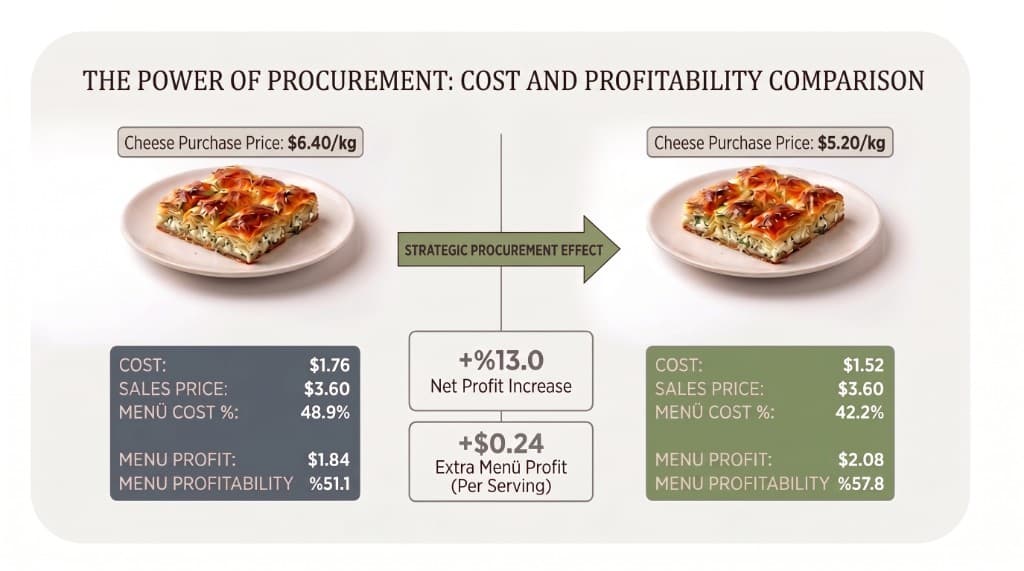
| Line | High purchase | Strategic purchase |
|---|---|---|
| Cheese purchase price | $6.40/kg | $5.20/kg |
| Portion cost | $1.76 | $1.52 |
| Sell price | $3.60 | $3.60 |
| Menu cost | 48.9% | 42.2% |
| Menu profit | $1.84 | $2.08 |
| Menu profitability | 51.1% | 57.8% |
Figures are an illustrative portion model. Real recipes and supplier prices vary by business.
The math of net profit growth: the 13.0% jump
Financial sustainability is not only about making revenue — it is about how efficiently you manage that revenue. When you optimize purchasing, you can move profitability from 51.1% to 57.8% without changing the $3.60 sell price at all. That is a full 13.0% jump in net profit. Through a strategist’s lens the data says this: you do not have to host more guests or throw advertising budget at the problem to earn more. Managing input cost is the shortest path to winning without adding operational load. Remember: a smart saving is the cleanest gain you can make — you do not take on the operational hassle of a new sale.
Invisible gain: an extra $0.24 per portion
The most concrete fruit of strategic buying is the extra $0.24 of menu profit per portion ($1.84 to $2.08). Twenty-four cents can sound small. To a restaurant strategist, that figure becomes serious working capital when it scales.
Imagine a business that sells only 100 portions a day — 3,000 a month. That “small” $0.24 per portion leaves an extra $720 of net profit in the till at month-end. That is enough for one item’s correct purchasing strategy to cover a utility bill or a month of marketing on its own. That is the invisible power of purchasing.
Close: a strategic question
The data is clear: purchasing is not only an “expense center” that pays invoices. It is a “profit center” that can save the financial future of the business. The real element that turns kitchen flavor into a financial success story is the right supplier management.
How do you capture this profit in your operation?
The gap above comes from choosing the right supplier at the right price. Chasing quotes by email and Excel misses that $1.20-per-kilo advantage. Qapera Purchasing Portal is completely free for purchasing departments: requests, quotes, approval workflow, orders, and supplier performance analysis in one portal.