
When you sell one pizza, do you really know how much you earn?
Most restaurants cannot answer this clearly. In this guide we calculate the real cost of one pizza step by step — using the same recipe logic operators need in the United States, the United Kingdom, the Netherlands, France, Poland, and across Europe.
Creating a product recipe happens in three steps: build sub-recipes (semi-finished products), combine those sub-recipes with portion ingredients, then set a selling price with a clear food-cost rule.
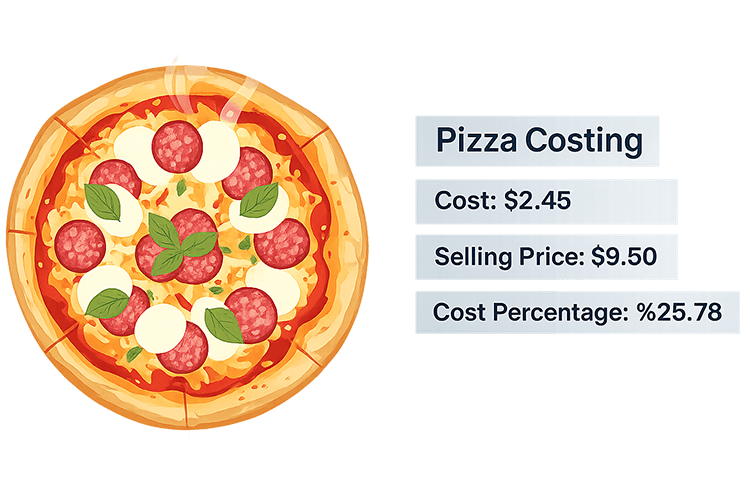
Step 1: Build sub-recipes on a 1 kg basis
We start from base production. Sub-recipes such as pizza dough and pizza sauce should be prepared and costed on a consistent basis — here, 1 kg — so every portion can pull an accurate unit cost.
Pizza dough recipe (1 kg)
| Product | Quantity | Unit price (per kg) | Cost (USD) |
|---|---|---|---|
| Flour | 600 g | $0.90 | $0.54 |
| Water | 360 g | $0.05 | $0.02 |
| Yeast | 20 g | $6.00 | $0.12 |
| Salt | 15 g | $0.30 | $0.01 |
| Olive oil | 25 g | $9.00 | $0.23 |
| TOTAL COST (1 kg dough) | $0.92 |
Always cost dough as a 1 kg sub-recipe so portion math stays clean.
Pizza sauce recipe (1 kg)
Apply the same logic to the sauce.
| Product | Quantity | Unit price (per kg) | Cost (USD) |
|---|---|---|---|
| Tomato purée | 850 g | $2.80 | $2.38 |
| Olive oil | 80 g | $9.00 | $0.72 |
| Garlic | 30 g | $4.50 | $0.14 |
| Salt & spices | 40 g | $1.50 | $0.06 |
| TOTAL COST (1 kg sauce) | $3.30 |
1 kg pizza sauce cost: $3.30
From production to one pizza portion
Now we move from batch production to one plated pizza. This pizza uses:
300 g pizza dough → $0.92 × 0.30 = $0.28
90 g pizza sauce → $3.30 × 0.09 = $0.30
Step 2: Combine all ingredients into plate COGS
Roll sub-recipes and toppings into a single Cost of Goods Sold (COGS) for one pizza.
| Product | Recipe quantity | Unit | Unit cost (USD) | Cost (USD) |
|---|---|---|---|---|
| Pizza dough (1 kg base) | 0.30 | kg | $0.92 | $0.28 |
| Pizza sauce (1 kg base) | 0.09 | kg | $3.30 | $0.30 |
| Mozzarella cheese | 0.12 | kg | $9.50 | $1.14 |
| Sucuk (Turkish sausage) | 0.06 | kg | $14.00 | $0.84 |
| Mushrooms | 0.05 | kg | $3.20 | $0.16 |
| Olives | 0.03 | kg | $4.50 | $0.14 |
| Olive oil | 0.01 | liter | $9.00 | $0.09 |
| TOTAL COST (food cost) | $2.95 |
This number is critical: $2.95 is your COGS for one pizza.
This is your Cost of Goods Sold (COGS) for one pizza.
Step 3: Pricing with the 1/4 rule
For a healthy dine-in restaurant operation, product (food) cost should not exceed about 25% of the selling price. This is often called the 1/4 rule.
What the 1/4 rule represents in a simple planning model:
25% raw material cost · 25% labor · 25% rent and operating expenses · 25% profit — the real purpose of the business.
| Menu name | Cost (USD) | Selling price (USD) | Food cost % | Gross contribution (USD) |
|---|---|---|---|---|
| Mixed pizza menu | $2.95 | $11.75 | 25.1% | $8.80 |
| Four cheese pizza menu | $2.70 | $10.60 | 25.4% | $7.90 |
| Margherita pizza menu | $2.30 | $9.00 | 25.5% | $6.70 |
| Smoked meat pizza menu | $3.50 | $14.00 | 25.0% | $10.50 |
Why recipes matter
A recipe is not just a cooking instruction. A recipe is the financial constitution of your restaurant.
Without recipes, prices are set by intuition, profit is guessed, and losses are noticed too late. With recipes, every product cost is clear, pricing is intentional, and profit is not luck — it is a result.
Recipe management is not a kitchen task. It is a business discipline.
Calculated businesses grow. Pricing by intuition is betting your business.
Important note: online delivery pricing is different
The 1/4 rule works well for in-store dining and direct customers. Delivery platforms often charge roughly 30–35% commission. That means you must add commission, packaging, and courier costs into the price. Online food pricing often requires closer to a 6–7× cost approach — not the same as dine-in.
| Menu | Total cost | Selling price | Food cost % |
|---|---|---|---|
| Mixed pizza (online) | $7.05 | $11.75 | 60% |
Commission + packaging + courier can add about +$4.10 in this example — crushing the dine-in 25% target if you keep the same shelf price.
Do not charge your in-store guests for online commissions.
In-store pricing → 1/4 rule. Online pricing → add commission and delivery costs. Online sales → often a 1/6 to 1/7 pricing logic. This keeps the business fairer, more transparent, and more trustworthy.
Closing
Start with one product — one pizza — and make the math visible. When every plate has a clear recipe and COGS, menu prices stop being guesses.
Those who calculate today are the ones who control tomorrow.
Qapera helps restaurants keep sub-recipes, plate costs, and menu pricing connected so food cost stays a daily decision — whether you operate in the US, UK, Netherlands, France, Poland, or elsewhere in Europe.